Kashish Dugar
I finished the book!
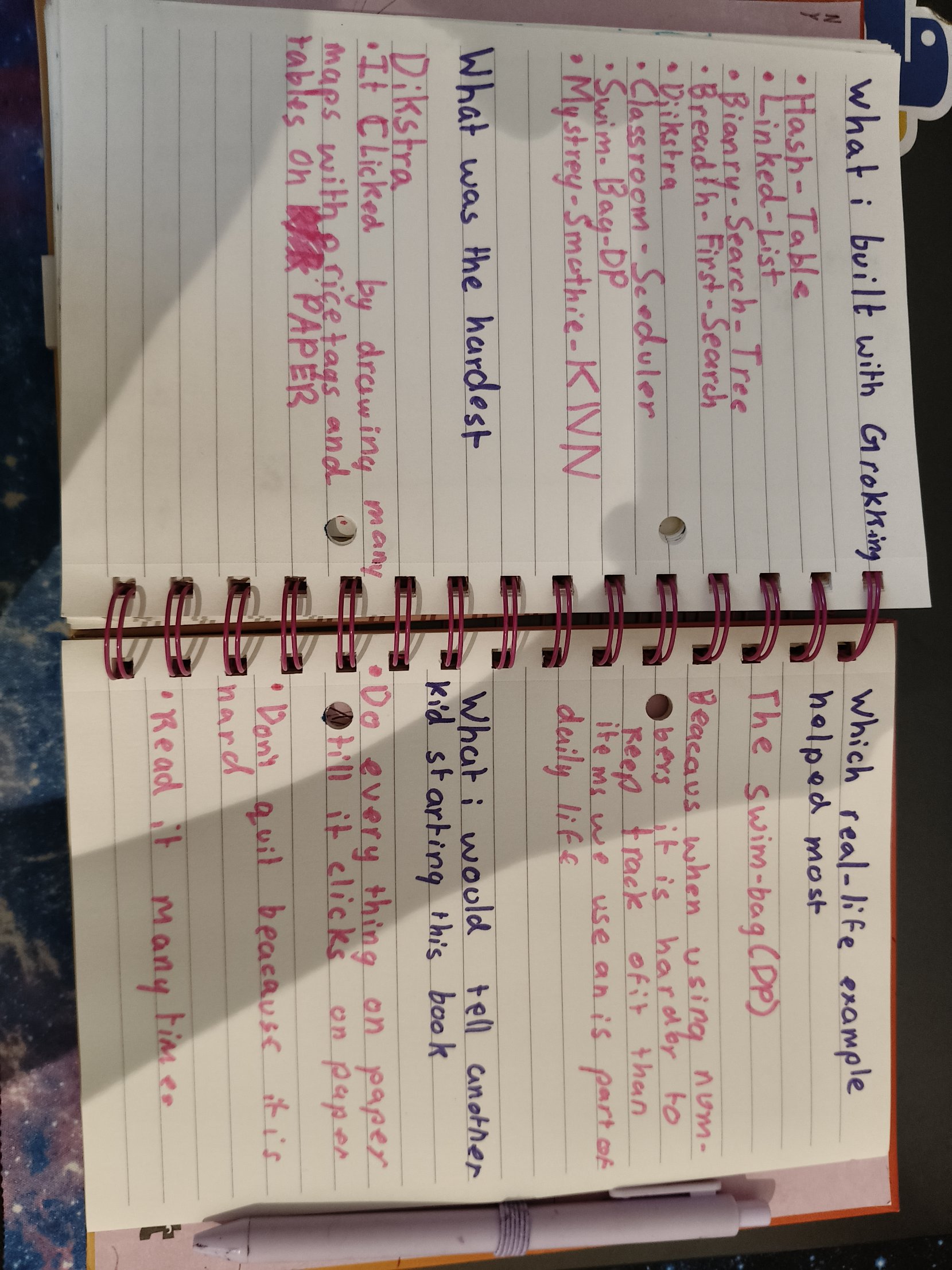
Today I read Chapter 11, the last chapter of Grokking Algorithms. I built every big idea from the book myself, book closed, paper first:
- Hash-Table
- Linked-List
- Binary-Search-Tree
- Breadth-First-Search
- Dijkstra
- Classroom-Scheduler
- Swim-Bag-DP
- Mystery-Smoothie-KNN
My 3 favourites from Chapter 11
- Linear programming: trying to swim the most with limited time. It’s like my swim bag!
- Diffie-Hellman: keeping secrets, like a secret club in the middle of the night. It reminded me of the Caesar cipher I built from The Big Book of Small Python Projects.
- Inverted indexes: they store which words are on which pages, like the index at the back of a book. It’s like my hash table.
Looking back
- Hardest: Dijkstra. It clicked when I drew lots of little maps with price tags on paper.
- Most helpful real-life version: my swim bag. When using numbers it is harder to keep track than with items we use, because they are part of daily life.
- My advice: Do everything on paper till it clicks on paper. Don’t quit because it is hard. Read it many times.
My SciPy India poster
I submitted a poster proposal to SciPy India 2026 about how I learn: make it mine, paper first, then code. The organisers are reviewing it. Here is my proposal.
Petzold: Other Number Bases
We use base ten and it is convenient because we have ten fingers. Zero acts as a placeholder. Without it, 205 would be 25!
If cartoon characters have 8 fingers, they would count 0, 1, 2, 3, 4, 5, 6, 7, 10, 11, 12, 13, 14, 15, 16, 17, 20. There is no 8 or 9.
In binary each finger has 2 positions, up or down. The fingers are worth 1, 2, 4, 8 and 16, so on one hand I can count to 31!
I started Rust!
Today I started Rust, and it got preponed! From now on, some days will be Rust and some days will be Miller & Ranum and once a week will be rewieng code bases. Rust-Book