Kashish Dugar
How far is far?
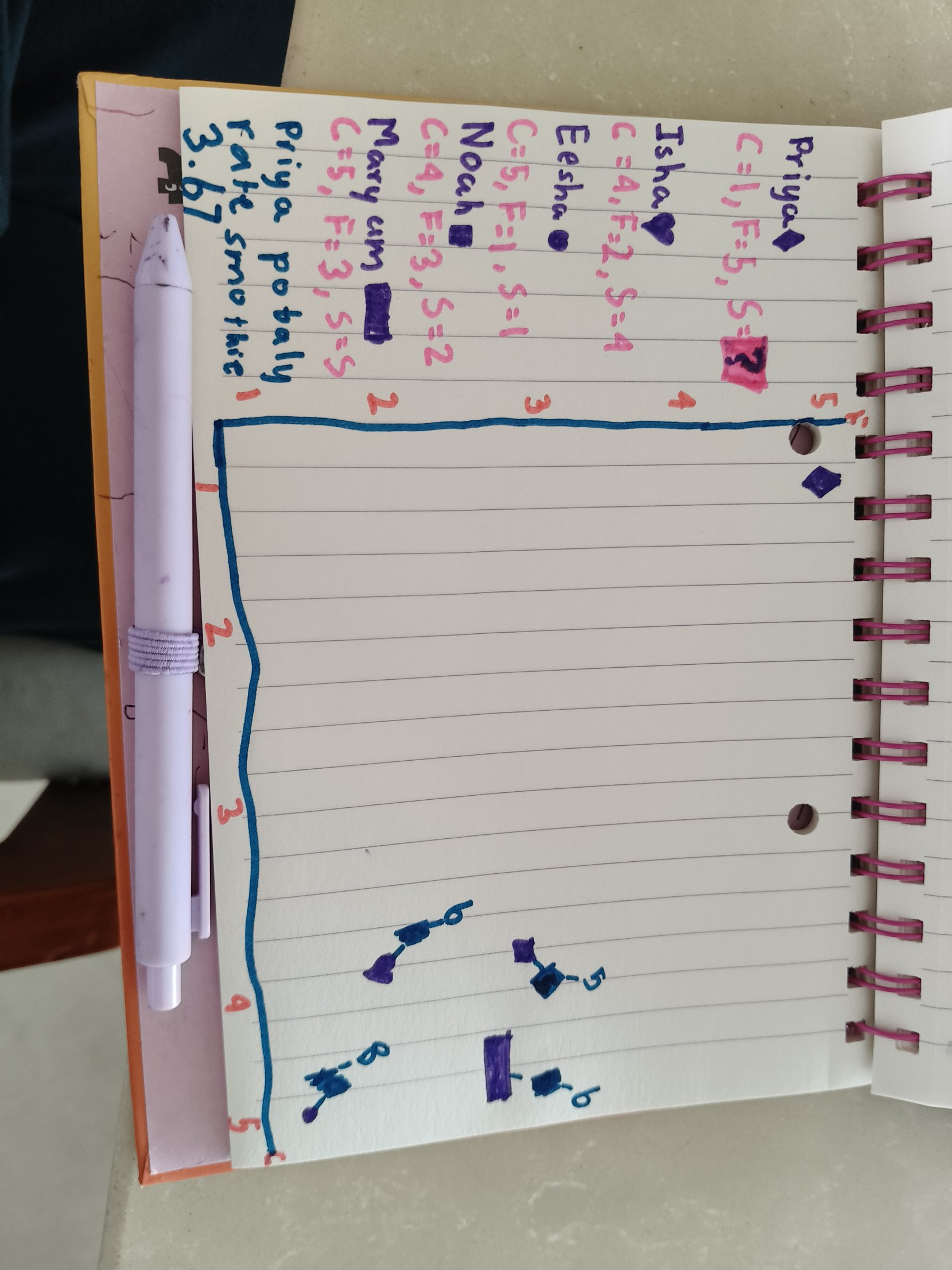
Priya and her friends rated chocolate and fruit from 1 to 5. If they lived on a grid of streets, Priya would walk 5 blocks to Noah: 3 across and 2 down.
But a crow flies straight. So the computer squares each part and adds them: 3 × 3 + 2 × 2 = 13. Noah 13, Isha 18, Maryam 20, Eesha 32. The smallest number means the most similar tastes.
You can’t just add someone’s ratings together. Priya (1 + 5) and Eesha (5 + 1) both make 6, but they have opposite tastes!
The mango smoothie
Then a new mango smoothie came out. Priya hasn’t tried it, so her rating is a mystery. Her 3 nearest friends rated it Noah 2, Isha 4 and Maryam 5. On paper I added them up (11) and divided by 3: Priya would probably rate it 3.67.
The code
I made a distance function and a find_closest function. find_closest is like find_cheapest from Dijkstra: it keeps the lowest distance and skips Priya and anyone already chosen. It runs 3 times to find the 3 nearest.
from ratings import *

chosen = []
total = 0

def distance(a, b):
    across = ratings[a]["chocolate"] - ratings[b]["chocolate"]
    up = ratings[a]["fruit"] - ratings[b]["fruit"]
    return across * across + up * up

def find_closest():
    lowest = float("inf")
    closest = None
    for name in ratings:
        if name != "Priya" and name not in chosen:
            if distance("Priya", name) < lowest:
                lowest = distance("Priya", name)
                closest = name
    return closest

for _ in range(3):
    freind = find_closest()
    chosen.append(freind)

for freind in chosen:
    total = total + ratings[freind]["smoothie"]
It printed [‘Noah’, ‘Isha’, ‘Maryam’] and 3.6666666666666665, the same as my paper answer! We trust the nearest friends because their tastes are most like Priya’s. Eesha is too far away.
Petzold: Our Ten Digits
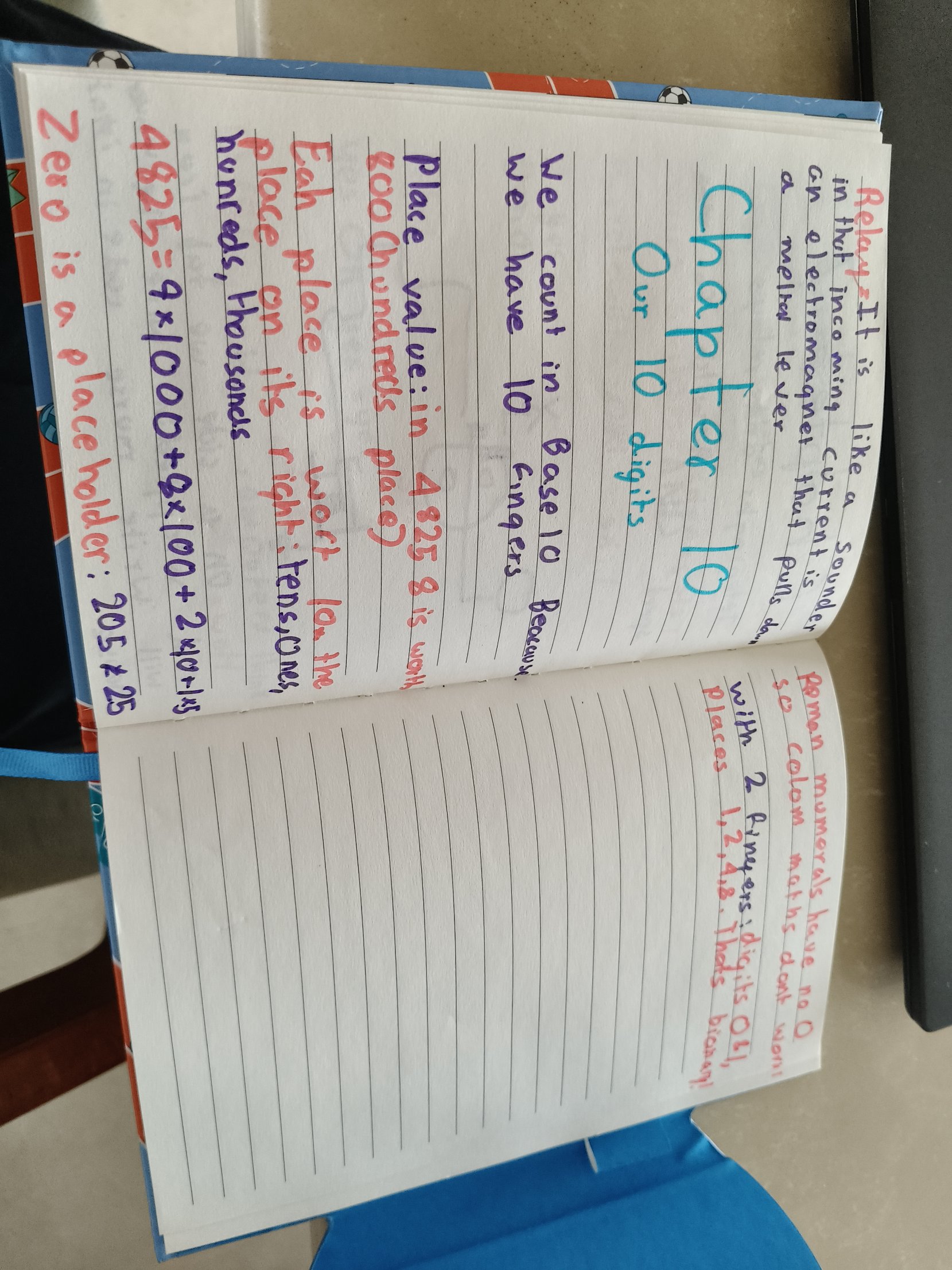
We count in tens because we have ten fingers. In 4,825 the 8 is worth 800 because it’s in the hundreds place. Zero is a placeholder, so 205 isn’t 25. With 2 fingers we’d only need the digits 0 and 1, and the places would be 1, 2, 4, 8. That’s binary!